What lies beyond our known universe?
In this article, universe refers to our own universe, while multiverse refers to the entirety of all universes.
Shape of Universes
Let’s travel back in time some 13.8 billion years. Our universe was unimaginably hot and dense. The temperature was so high that no material structures could form, not even atoms. There were only tiny elementary particles and radiation.
Time passed, and our universe gradually cooled. It took nearly 400,000 years for the first neutral atoms to form and for light to finally travel freely. What a relief that must have been for the photons, which had spent all that time constantly colliding with other particles, unable to get far! The cosmic microwave background radiation we can still detect dates back to that time.
Millions more years passed before the first stars began to shine. Since then, countless stars have formed. So many that the observable universe is now estimated to contain as many as a million trillion stars. While the most massive stars die after just a few million years, some ancient, low-mass stars are still shining today.
Determining the shape of our universe, however, is far more difficult. Scientists have studied the cosmic microwave background radiation and the distribution of galaxies to better understand the geometry of space. These observations suggest that space is nearly flat on large scales, meaning its curvature is very close to zero. But this tells us only about the internal geometry of space, not the possible outer shape of our universe. Despite all the information we gather from distant galaxies and cosmic radiation, we still have no way to observe or measure that possible outer shape.
The observable universe is approximately 93 billion light-years across. This estimate is based on the age of the universe and how much space has expanded while light has been traveling toward us. But this is only the region we can observe. We do not know how much farther our universe extends beyond it.
We can only speculate about its actual size and outer shape, as well as our location within it. If our universe has outer regions that gradually fade into surrounding space, the number of galaxies and other celestial objects might decrease with increasing distance in certain directions. We might even detect faint radiation originating from beyond those regions.
We know even less about other universes. Are they all alike, or completely different? Could they be flattened, hyperspherical, doughnut-shaped, or something else entirely? How much might their shapes change over time as matter and energy spread farther apart? Nor do we know how old they might be or how different universes might interact with one another. The illustration below shows just a few possible shapes.
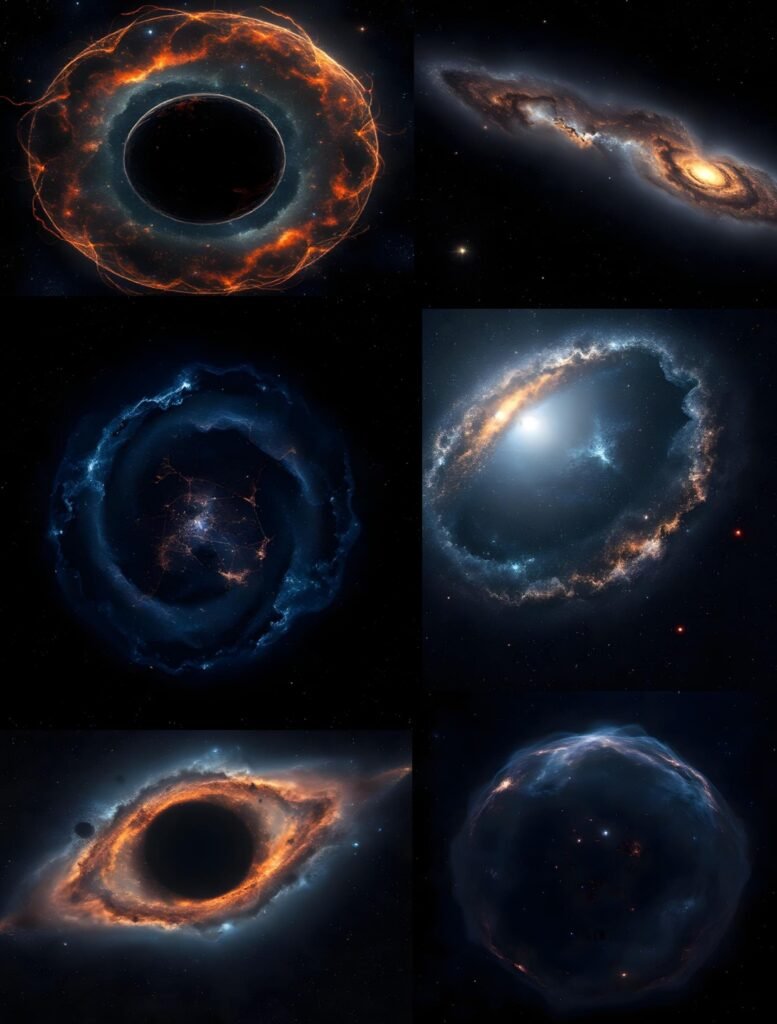
Structure of Multiverse
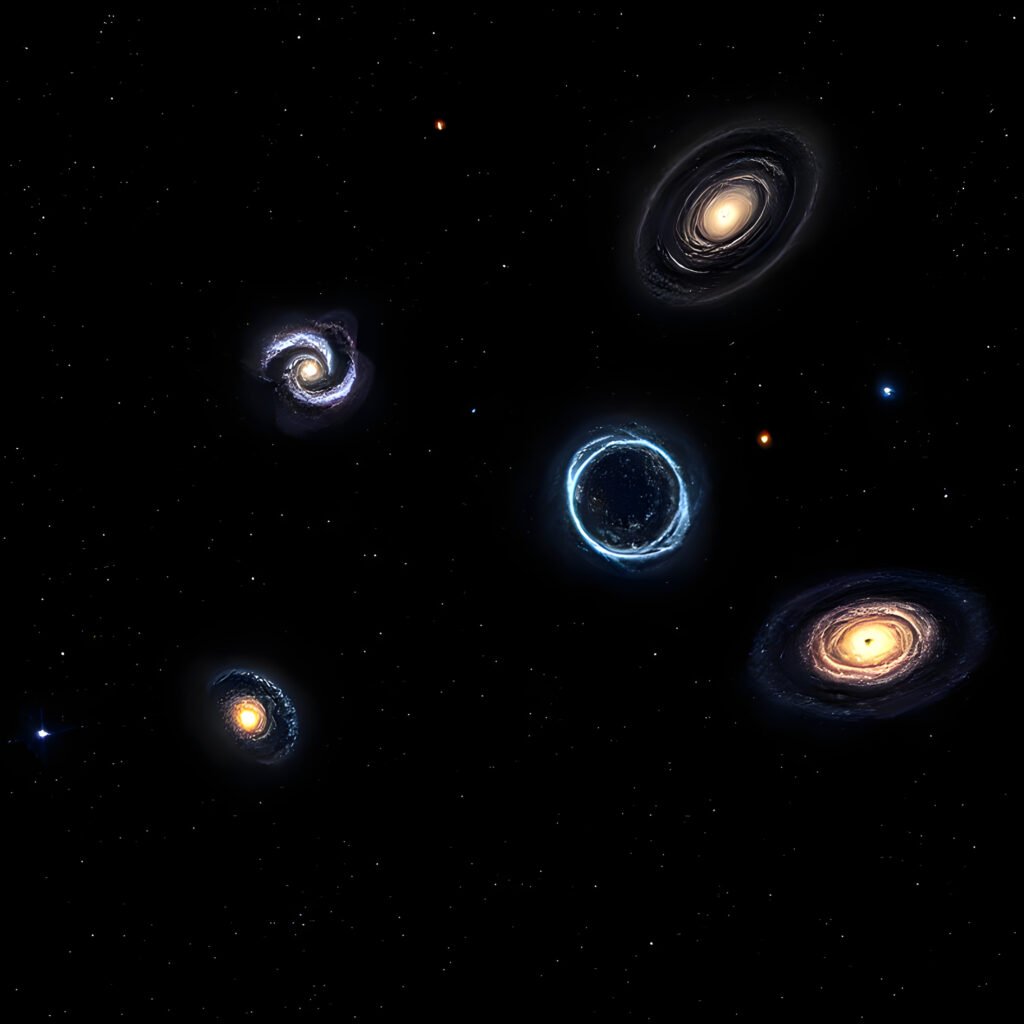
The multiverse comprises an infinite number of universes of different ages and sizes. It is not a static or unchanging system. Every universe is constantly evolving, just as the galaxies, stars, nebulae, black holes, and other celestial objects within them are constantly changing.
Although our current technology is insufficient to detect anything beyond our own universe, we can still imagine what might exist there. Space itself cannot simply come to an end.
Imagine choosing a distant star in the night sky and drawing a perfectly straight line from yourself to it through three-dimensional space. Continue that line beyond the star, through our galaxy and countless others. Eventually, after unimaginable distances, it reaches another universe. It passes through that universe as well, continues onward through another immense expanse, and eventually reaches yet another universe and so on, forever.
We don’t know how our universe came into being or what its ultimate fate will be. Was it born from the remnants of a previous universe, or from the collision and merging of neighboring universes? Will it continue expanding forever, contract, or eventually merge with another universe?
The multiverse is eternal and infinite. Its immense scale may be one reason why humanity has not yet encountered civilizations far more advanced than our own. Another possibility is that such civilizations could visit us without us ever realizing it.
Some theories suggest that an infinite number of identical universes exist, including exact copies of our own. According to this idea, each of us would have counterparts living parallel lives in other universes.
I see things differently. To me, every universe is unique. Even if space and the amount of matter are infinite, that does not necessarily imply that universes must repeat themselves. The number of possible evolutionary paths is also infinite, making every universe the product of its own history. The multiverse may be infinite, but that does not mean it contains endless copies of the same reality.
The Mystery of Gravity
Gravity governs the motion of planets, stars, and galaxies. It also determines what happens when you drop a stone. But how does the stone know which way to fall? What tells it where to go?
We call it gravity. We can calculate its effects with remarkable accuracy, yet its fundamental nature remains a mystery. But what causes gravity?
Is gravity transmitted by particles, as some theories suggest? What is the fundamental nature of the gravitational field? Or does the answer lie in something else entirely?
Einstein’s general theory of relativity describes gravity as the curvature of spacetime caused by mass and energy. It successfully predicts gravitational effects, but it does not explain whether a deeper physical mechanism underlies this relationship.
The hypothetical graviton has never been detected, and gravity has not been successfully unified with quantum mechanics.
But what if gravity is not a fundamental force at all?
Some physicists have explored this possibility. Erik Verlinde’s theory of emergent gravity describes how gravitational effects could arise from deeper physical processes, including an elastic response of space. Other theoretical approaches have also explored the idea of spacetime behaving like an elastic medium, responding to disturbances and stresses.
Perhaps gravity is not simply an attractive force, but a consequence of how space itself responds to matter and energy throughout the multiverse.
These ideas form the foundation of my science fiction novel Discovery: Prelude to a New Era. It explores the possibility that intelligent civilizations have lived in universes that formed, flourished, and disappeared long before our own universe was born. As the story unfolds, the main characters journey beyond our own universe and encounter civilizations whose understanding of life and the multiverse far surpasses our own.